
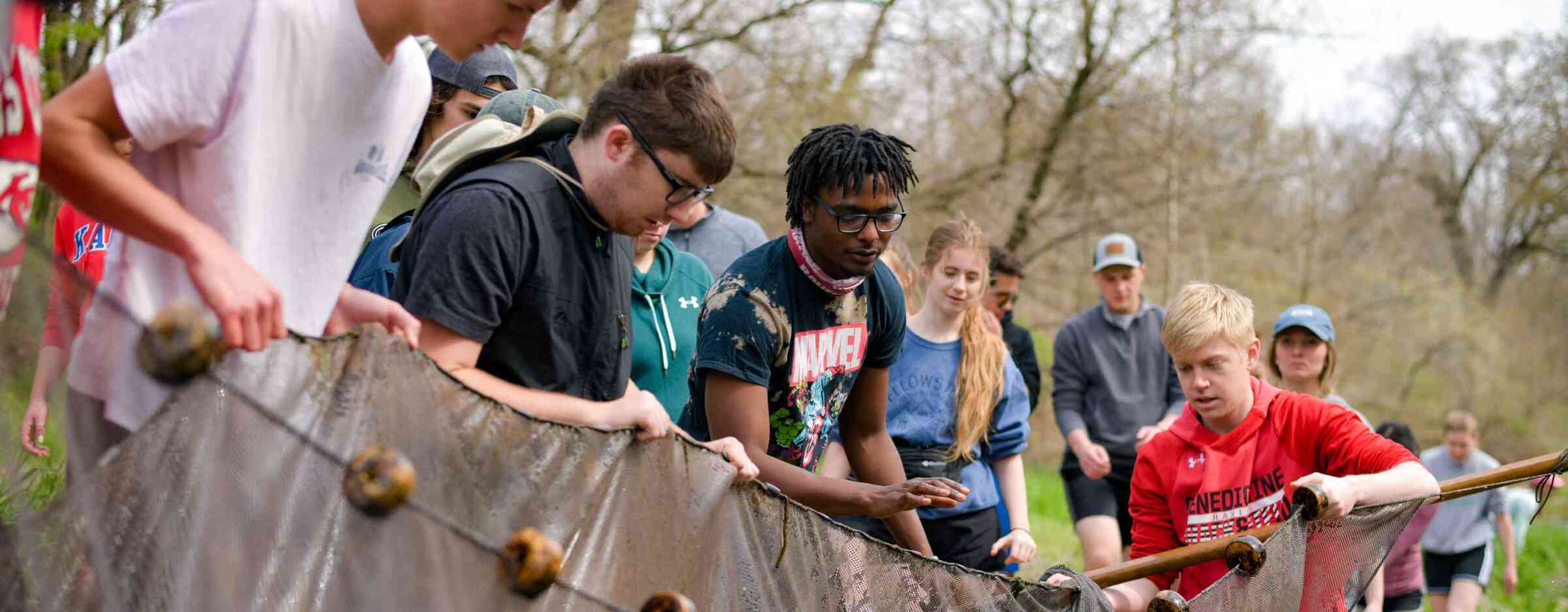
The Center for Integral Ecology at Benedictine College exists to meet the unprecedented ecological crisis facing our world today. The Center’s vision is consistent with Catholic social teaching’s emphasis that both the created world and the most vulnerable of society are a gift from God to be cherished and cared for.
Conscious of papal teaching that we cannot hear the cry of nature when we fail to acknowledge the dignity of persons, this holistic approach advanced by recent popes brings together concern for conservation and understanding of the natural world (environmental ecology) with an emphasis on the unique place and responsibility of the human person within creation (human ecology).
Center Stories & Media
Events
Formation, Extension, Profession
Following the Transforming Culture in America Strategic Plan, the Center for Integral Ecology provides for the following key areas of Formation, Extension and Profession.
Formation
- The Center for Integral Ecology attracts students who are interested in undertaking sustainability work related to environmental stewardship, beginning with a recognition of human dignity and our grave responsibility to care for Creation.
- The Center for Integral Ecology is developing an interdisciplinary minor in Environmental Studies at Benedictine to train the next generation of environmental leaders. The minor will garner wide interest through its two tracks in the fields of science/technology and the humanities.
- The Center sponsors opportunities for students to attend national and regional conferences organized around issues of environmental stewardship and Catholic thought on the mutual enrichment of faith and science.
Extension
- Students will gain valuable skills in applying academic learning to address community needs.
- To cultivate an environmentally literate citizenry, the Center will develop educational materials that properly frame the difficult and contentious issues surrounding climate, human dignity, and other matters related to care for creation.
- The Center will host speakers and provide programming for the local community that will invite others to take responsibility for finding solutions and cultivating the ecological virtues in their lives.
Profession
- The Center for Integral Ecology serves as a networking venue for graduates to find employment in the public and private sectors, research and environmental policy/advocacy.
- Students involved in the center will participate in service and research projects that incite the desire to protect creation.
Directors

Associate Professor, Chemistry and Biochemistry
Dr. Patrisha Pham Bugayong earned her Ph.D. degree in Chemistry from Mississippi State University in 2009. Her graduate research focused on the chemical synthesis and development of innovative separation methods involving molecular tagging, ionic liquids and chiral proline with pharmaceutical and renewable energy applications. Previously, Dr. Bugayong earned her Bachelor of Science degree in Chemistry from the University of the Philippines Los Baños. After completing her Ph.D., she worked as a Postdoctoral Researcher at the Dave Swalm School of Chemical Engineering at Mississippi State University from 2009 to 2013. At MSU, she developed chemical materials and methodologies for the conversion of activated sludge biomass to renewable energy and value-added products. In 2013, she pursued additional postdoctoral research work at the Audubon Sugar Institute of Louisiana State University AgCenter. At LSU, she worked on lignocellulosic biomass conversion to renewable energy and value-added products. To date, she has authored/co-authored 16 peer-reviewed publications, 8 book chapters and has made over 60 paper and poster presentations. In August 2015, she joined the faculty of Benedictine College where she is an Assistant Professor in organic chemistry.

Professor, Theology
Matthew J. Ramage, Ph.D. is full Professor of Theology at Benedictine College where he is co-director of the Center for Integral Ecology. His research concentrates on the theology of Joseph Ratzinger, the wedding of ancient and modern biblical exegesis, the development of a Catholic theology of creation capable of grounding a distinctively Christian environmentalism, and the recovery of embodied human flourishing in an age of technological saturation. Toward this end, he serves as founding President of the Two Books Network, Scholar Associate of the Society of Catholic Scientists, partner of the International Ratzinger Foundation, member of the Academy of Catholic Theology, and collaborator in University of Notre Dame–based international working groups on Integral Ecology and Vatican II. An author or contributor to over thirty books, Ramage’s monographs include Dark Passages of the Bible (CUA, 2013), Jesus, Interpreted (CUA, 2017), The Experiment of Faith (CUA, 2020), Christ’s Church and World Religions (Sophia, 2020), From the Dust of the Earth (CUA, 2022), The Essential Guide to Ratzinger (OSV, 2025), Cosmic Covenant: A Catholic Theology of Creation (Word on Fire Academic, 2026).