
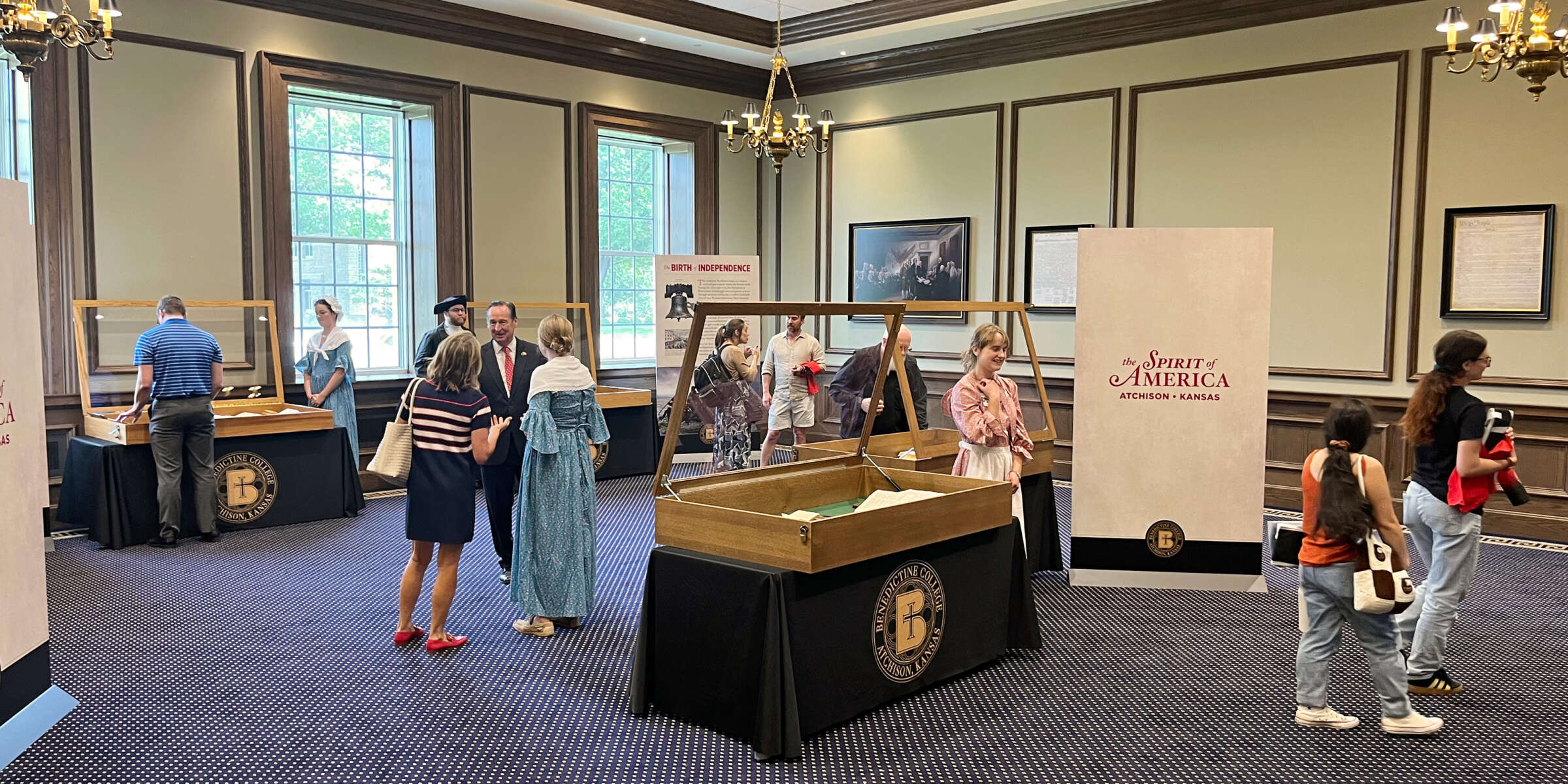
Two hundred and fifty years ago, thirteen colonies declared their independence and embarked upon a revolutionary experiment in republican self-government. Drawing from centuries of reflection on law, liberty, equality, and human dignity, the Founders sought to create a nation dedicated to the proposition that all men are created equal.
At its founding, the United States was a hope as much as a nation — a hope that free people could govern themselves while preserving liberty, virtue, and justice. This exhibit traces the ideas, documents, and debates that shaped the American Experiment and the nation that emerged from it.
Explore the Documents
- Ideas that Shaped a Nation
- The Birth of Independence
- The Constitution and Beyond
- The Nation Tested
- Medieval Catholic Thought
- About the Exhibit
Ideas that Shaped a Nation
The American Founders inherited ideas from a broad intellectual tradition. Thinkers articulated principles of human equality and political consent that would influence later philosophers and statesmen, including many of the Founders themselves. Discover the ideas about equality, consent, and opposition to arbitrary rule that Jefferson and the Committee of Five drew upon when drafting the Declaration.
Aristotle’s Politiques, or Discourses of Government
Aristotle
1598 – 1st English Edition
In this work, originally written in 350 B.C., Aristotle explores the purpose of political community, the nature of citizenship, the best forms of government, and the relationship between virtue and political life.
Reference #0027
Cato’s Letters
John Trenchard and Thomas Gordon
1724 – 1st Edition
These essays draw upon the English republican tradition arguing that liberty depends upon civic virtue, self-government, and resistance to arbitrary power. Cato’s Letters was especially influential during the American Revolutionary period; the Letters could be found in approximately half of the private libraries in the American colonies.
Reference #0052-0055
Two Treatises of Government
John Locke
1694 – 2nd Edition Corrected
The first treatise attacks Sir Robert Filmer’s defense of the divine right of kings. The second argues that all men are naturally equal and that legitimate government rests upon the consent of the governed rather than hereditary claims to political authority.
Reference #0205
The Spirit of Laws
Baron de Montesquieu (Charles-Louis de Secondat)
1752 – 2nd Edition
Montesquieu examines the principles that sustain different forms of government and argues that political liberty is best preserved through a constitutional system that separates political power. He also criticizes slavery and arbitrary rule.
Reference #0259-0260
Discourses Concerning Government
Algernon Sidney
1698 – 1st Edition
Discourses was written in response to Robert Filmer’s Patriarcha. Sidney defends political equality and government by consent while rejecting the divine right of kings. He cites Cardinal Robert Bellarmine directly and favorably.
Reference #0315
Nicomachean Ethics
Aristotle
1488 – Manuscript
Written around 335 B.C., Aristotle argues that human happiness is achieved through a life of virtue in accordance with reason. He examines justice, practical wisdom, friendship, and the moral formation necessary for human flourishing.
Reference #0672
Controversiae
Robert Bellarmine
1590-1593
Bellarmine’s Controversies addresses many of the central religious and political disputes of the Reformation era. In discussing political authority, he argues that while authority ultimately comes from God, God does not directly appoint particular rulers. Because no person possesses a natural right to rule all others, political communities possess a role in determining their form of government and selecting rulers who serve the common good.
Reference #0752-0754
Tully’s Offices in Three Books
Marcus Tullius Cicero
1680 – 1st Edition English
Cicero’s De Officiis, written in 44 B.C., examines virtue, justice, moral obligation, and the responsibilities of citizens and statesmen. Its teachings profoundly influenced later Christian thought and political philosophy.
Reference #0941
The Birth of Independence
The American Revolution began as a dispute over self-government within the British world. The Declaration of Independence transformed these and other grievances into a statement of political principle. Explore how ideas about equality and legitimate government moved from the realm of political philosophy into the founding principles of a new republic.
An Act of the Parliament of Great Britain Pertaining to the Stamp Act of 1765
Great Britain
1766 – 1st Edition English
The Stamp Act of 1765 taxed most paper documents in the American colonies and was then repealed in 1766 due to protests in the colonies. This act on display cancelled any penalties incurred during the lifetime of the Stamp Act. It also validated the documents issued in violation of the Stamp Act.
Reference #0003
The Massachusetts Government Act (One of the ‘Intolerable Acts’)
Great Britain
1774 – 1st Edition
This act revokes the 1691 charter of William and Mary. It reduced authority from the Massachusetts colonial assembly while it gave the Crown and Parliament control over the mode of appointment, makeup of the council, and the manner of selection of judges.
Reference #0004
Journals of the Pennsylvania Assembly Containing the Declaration of Independence
United States
1777 – 3rd Edition
This is one of the first printings of the Declaration of Independence. It was printed by John Dunlap and is one of three known to exist in the world.
Reference #0100
Common Sense
Thomas Paine
1776 – 6th Edition
This 6th edition was printed in the same year as the 1st edition, which was anonymously published on January 10, 1776. Common Sense became the most widely circulated document at the time, going through twenty-five editions in its first year; one in six households owned a copy.
Reference #0270
The Crisis: In Thirteen Numbers. Written During the Late War
Thomas Paine
1792 – 1st Edition Collected American
This work was written by Thomas Paine between December 23, 1776, and April 19, 1783. Paine proposes plans for the taxation and strengthening of the American Union.
Reference #0272
The Constitution of the Pennsylvania Society, for Promoting the Abolition of Slavery, and the Relief of Free Negroes, Unlawfully Held in Bondage
Pennsylvania Society for Promoting the Abolition of Slavery (Benjamin Franklin, President; Benjamin Rush, Secretary)
1787 – 1st Edition
Founded in Philadelphia in 1774, the Pennsylvania Abolition Society was the first of its kind in America and a model for anti-slavery groups nationwide. This charter marks the Society’s 1787 reorganization, which drew in Franklin and Rush to lend national stature. The Pennsylvania acts for the gradual abolition of slavery are included.
Reference #0453
The Writings of Thomas Jefferson
Thomas Jefferson, ed. Thomas Jefferson Randolph
1829 – 1st Edition
The work was edited by Thomas Jefferson Randolph, Thomas Jefferson’s eldest grandson and the executor of his estate. It is a collection of Thomas Jefferson’s works and reflections throughout his life.
Reference #1183-1186
The Constitution and Beyond
Rather than creating a pure democracy, the Constitution established a republic that combined popular government with constitutional limits. Learn how the Founding Fathers translated the principles of the Revolution into a durable constitutional order.
A Defence of the Constitutions of Government of the United States of America
John Adams
1788 – 1st Edition Boston
Drawing upon examples from ancient and modern history, Adams examines the strengths and weaknesses of different forms of government. Rejecting both absolute monarchy and simple democracy, he argues that liberty is best preserved through a balanced constitution that combines and moderates the powers of the one, the few, and the many.
Reference #0020
The Federalist
Alexander Hamilton, James Madison, and John Jay
1788 – 1st Edition
This collection of eighty-five essays was written under the pseudonym “Publius” to defend the proposed Constitution. The authors argue that Americans could establish good government through reflection and choice by creating a constitutional republic capable of governing effectively while securing the blessings of liberty. This edition was owned by a member of the Virginia House of Burgesses.
Reference #0121
Journal of the First Session of the Senate of the United States of America, begun and held at the City of New York, March 4th, 1789
United States
1789 – 1st Publication
The journal includes the seventeen amendments to the Constitution proposed by the House of Representatives that were rejected by the Senate, as well as the twelve amendments that were approved and sent to the states for ratification. This volume also contains President Washington’s first address to Congress, the first rules of the Senate, and debates about legislation. It is the first congressional record.
Reference #0546
Travels to the Source of the Missouri River and Across the American Continent to the Pacific Ocean
William Clark and Meriwether Lewis
1814 – 1st Edition English
This is the official account of the Lewis and Clark expedition from their travels. They stopped in Atchison, Kansas, on July 4, 1804, and celebrated the first recorded Independence Day west of the Mississippi River.
Reference #0661
Message from the President of the United States Documenting the Official Transfer of the Louisiana Territory
Thomas Jefferson
1804 – 1st Edition
The United States purchased the Louisiana territory from France and Napoleon Bonaparte in 1803. At a cost of $15 million, the acquisition added 828,000 square miles of territory, including lands that would later become part of fifteen U.S. states and two Canadian provinces.
Reference #0726
The Constitution of the United States
United States
1788 – 1st Edition Connecticut Printing
This 1st edition is one of five known copies. This is the first official printing of the Constitution of the United States between the Connecticut ratification and the Constitution becoming effective in the United States on March 4, 1789.
Reference #0728
A Collection of Two Works Against the United States Constitution
Federal Farmer
1787-1788
These collected letters argue that the proposed Constitution would weaken the sovereign states in favor of a consolidated government which would destroy American liberties.
Reference #0821
The Nation Tested
During the 19th century, Americans increasingly disagreed about the meaning of the principles enshrined in the Declaration and Constitution. The Civil War was not only a struggle over the future of the Union but also a struggle that affirmed the principles proclaimed in 1776. Uncover the national debate over the meaning of human equality, citizenship, liberty, and self-government.
Narrative of the Life of Frederick Douglass, an American Slave
Frederick Douglass
1846
This is considered one of the most influential works in literature and it helped fuel the abolitionist movement in the United States as it tells the life story of Frederick Douglass from slave to freeman. The volume sold 5,000 copies within four months of its publication and approximately 30,000 by 1860.
Reference #0109
An Oration Delivered on the Battlefield of Gettysburg at the Consecration of the Cemetary, including Lincoln’s Gettysburg Address
Edward Everett and Abraham Lincoln
1863 – 1st Edition
This is the first printing of the Gettysburg Address in book form. It is only preceded by the very rare pamphlet printing called “The Gettysburg Solemnities.” The document contains the 272-word speech Lincoln delivered on November 19, 1863.
Reference #0197
Decision of the U.S. Supreme Court in the Case of Dred Scott vs. John F.A. Sandford
U.S. Supreme Court
1857 – 1st Edition
In this decision, the Supreme Court ruled that persons of African descent could not be citizens of the United States and held that Congress lacked authority to restrict slavery in the territories. Through a controversial interpretation of the Fifth Amendment’s Due Process Clause, the Court declared the Missouri Compromise unconstitutional and intensified the sectional conflict over slavery.
Reference #0389
Democracy in America
Alexis de Tocqueville
1836 – 2nd Edition of Part I
This is the second edition of Part I, in two volumes, with the original fold-out map. The first part of Tocqueville’s Democracy in America appeared in 1835 (the second part followed in 1840); this is its 1836 reprinting. The work grew out of the 1831–1832 American tour that Tocqueville undertook with Gustave de Beaumont. Part I examines the institutions and mores that sustain American self-government such as the New England township, religion, civic associations, and the habits of the citizenry. It also warns of a distinctive democratic danger, the tyranny of the majority.
Reference #0352-0353
The Unconstitutionality of Slavery
Lysander Spooner
1856
In this work, Spooner argues that slavery violates natural law and lacks constitutional legitimacy. He contends that the Constitution’s text contains no legal recognition of property in persons.
Reference #0747
The Leavenworth Constitution
Kansas
Adopted by delegates in 1858 and printed in 1859
This proposed constitution for the state of Kansas prohibits slavery and grants civil and political rights to black men that were uncommon in the United States at the time. It was never adopted as the state’s constitution.
Reference #1460
Medieval Catholic Thought
Medieval Christian thinkers, such as Augustine and Aquinas, shaped centuries of Christian thought about justice, law, and political community. See how their study of enduring questions of God, truth, justice, political authority, and human dignity reflect many of the very same questions that animated the Founders.
Summa Theologiae, Secunda Secundae
St. Thomas Aquinas
1472-1475 – Incunable
This portion of Aquinas’s Summa Theologiae, originally written in the thirteenth century, examines the virtues and vices that shape human conduct. It is organized around the theological virtues (faith, hope, and charity) and the cardinal virtues (prudence, justice, fortitude, and temperance). It is one of the most influential works of moral, political, and theological thought in the Western tradition.
Reference #0023
Of the Citie of God: With the Learned Comments of Vives
St. Augustine of Hippo; translated by John Healey
1610 – 1st Edition English
This is translated by John Healey from the original Latin and includes the commentary of Juan Luis Vives. Written in the early fifth century A.D., City of God contrasts the city of God and the earthly city, two communities formed by different loves and ultimate ends.
Reference #0029
The Idiot in Four Books
Nicholas of Cusa
1650 – 1st Edition
Written in the fifteenth century, these four dialogues explore wisdom, human understanding, and the search for truth. The final dialogue considers how measurement and empirical observation can contribute to knowledge of the natural world.
Reference #0470
Sentences and On the Contemplative Life
St. Isidore of Seville
1400
This volume contains Isidore’s Sentences and On the Contemplative Life, both originally written in the early seventh century. These works draw together the wisdom of Scripture and the Church Fathers while reflecting on moral formation, pastoral leadership, and the contemplative life.
Reference #0483
The Confessions of the Incomparable Doctour S. Augustine
St. Augustine of Hippo
1620 – 1st Edition
Written between 397 and 400 A.D., Confessions recounts Augustine’s spiritual journey from youthful ambition and error to conversion and the Catholic faith. It remains one of the most influential works of Christian autobiography and reflection on truth, happiness, and the human soul.
Reference #0500
Consolation of Philosophy
Anicius Manlius Severinus Boethius
1400-1425 – Manuscript
Originally written in the sixth century, this dialogue between Boethius and Lady Philosophy explores fortune, happiness, virtue, justice, providence, and free will. Confronting the apparent prosperity of the wicked and suffering of the just, Boethius argues true happiness is found not in wealth, power, or fame, but in the pursuit of wisdom and virtue.
Reference #0681
De miseria humanae conditionis (On the Misery of the Human Condition)
Innocent III (Lotario dei Conti di Segni)
1250 – Manuscript
Written by Lotario dei Conti di Segni before his election as Pope Innocent III at the end of the twelfth century, this work reflects on the frailty and transience of human life. Its meditation on human weakness and mortality became one of the most widely read devotional works of the Middle Ages.
Reference #0896
Biblia Pauperum, bound with Omer Talon, Rhetoricae Libri Duo
Pseudo-Bonaventure (attrib.); Omer Talon.
First text dated 1518; Talon’s Rhetorica later
This is a composite volume of two printed texts bound together. The first, traditionally titled Biblia Pauperum and ascribed to St. Bonaventure, is not the illustrated Paupers’ Bible but a text-only collection of scriptural exempla for preachers. Bound with it is the Rhetorica of Omer Talon (Audomarus Talaeus), a standard text on style and delivery.
Reference #0933
The King James Bible “He” Version
Robert Barker
1611 – 1st Edition
There were two editions of the King James Bible printed in 1611, which are distinguished by a mistake printing of Ruth 3:15. The incorrect edition reads “he went into the city,” whereas the correct edition reads “she went into the city.” This edition includes the “he” version of the verse.
Reference #1063
Liber Trium Virorum and Trium Spiritualium Virginum (Book of Three Men and Three Spiritual Virgins)
St. Hildegard of Bingen; Hermas; Uguetin de Metz; Elizabeth of Schönau et al
1513 – 1st Edition
The volume contains a very rare first edition and first appearance in print of Hildegard of Bingen’s Scivias Libri Tres, published in 1513. Scivias was prepared from manuscripts of the French humanist Jacques Lefevre d’Etaple, only eight of which survive today.
Reference #1207
St. Bernard’s Opera Omnia
St. Bernard of Clairvaux
1667 – 1st Edition
This edition is a collection of the writings of Bernard of Clairvaux, one of the most influential spiritual and theological figures of the Middle Ages. Through sermons, letters, and theological treatises, Bernard shaped medieval monasticism and helped define the spiritual life of Western Christianity.
Reference #1348
About the Exhibit
The rare documents on display in the new, Independence Hall-inspired Moritz Library are on loan through November 2026 from the Remnant Trust, one of the nation’s preeminent collections of original primary source materials.

Thirty-nine documents trace the story of the American Founding and its origins in centuries of Western political thought. Among them are works by Aristotle, Cicero, John Locke, and Algernon Sidney, as well as the Declaration of Independence, the Federalist Papers, and a rare 1788 printing of the Constitution of the United States, one of only five known copies in existence.
Rather than presenting these documents as isolated artifacts, the exhibit invites visitors to engage with enduring questions about natural rights, political authority, human equality, and constitutionalism, and to reflect on the principles and debates that have defined the American experiment in self-government.
This exhibit was made possible through the generous support of the Haverty Family Foundation and the William T. Kemper Foundation.